
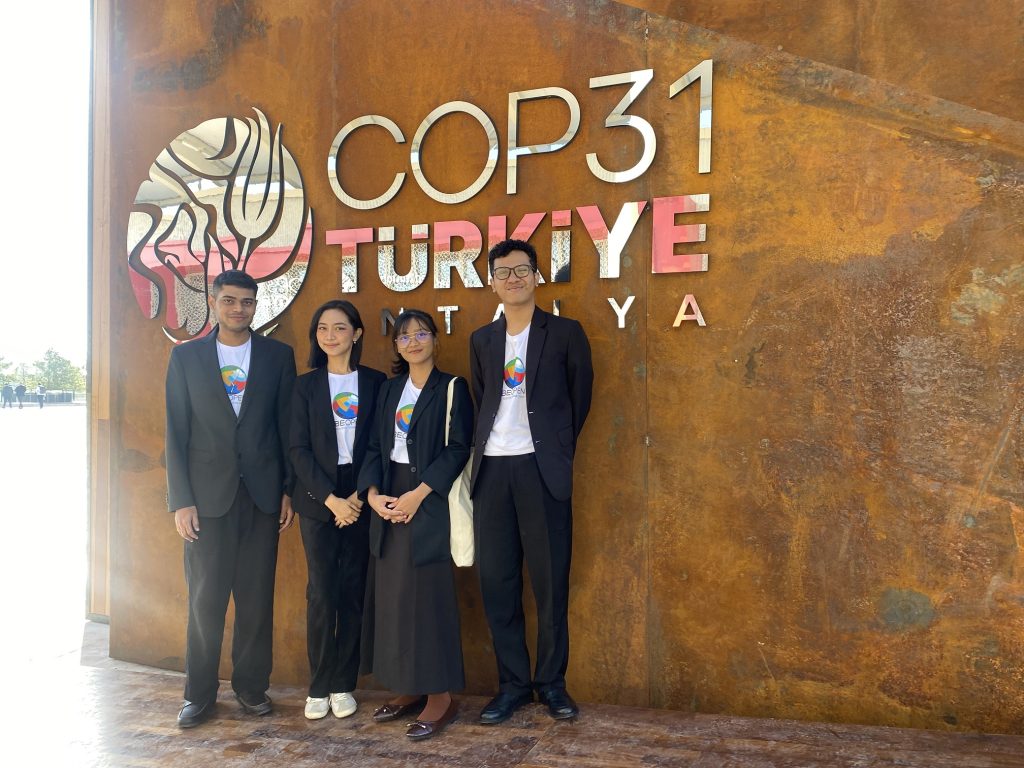
November 16, BE OPEN presented the winners and the winning projects of Design Equality with Innovation competition at the Zero Waste Hub in the Green Zone of COP31 in Antalya, Turkey.
Design Equality with Innovation is the latest of the SDG-focused student design competitions BE OPEN organised as part of its annual programme to support the UN Sustainable Development Programme.
At the Zero Waste Hub of COP31, the foundation shared the motivation behind the student competition programme that focuses on one sustainable goal every year, and has so far covered SDG5: Gender Equality, SDG12: Responsible Consumption and Production, SDG11: Sustainable Cities and Communities, SDG2: Zero Hunger, SDG7: Affordable and Clean Energy and SDG13: Climate Action. The programme aims to encourage creation of innovative solutions by younger creatives, for a more prosperous and sustainable future.
In her address to the guests of COP31, Founder of BE OPEN Elena Baturina explains BE OPEN’s commitment to the programme: “Every year we collect hundreds of outstanding, well-researched, creative projects from young people all over the world. Every year we get reassurance that educating and motivating young people to become leaders of sustainable change is the best way forward. And every year we try to do more by offering them a platform for discussion and exchange of ideas, offering them opportunities for self-education, boosting their confidence and helping them to see that they matter.”
The presentations of the winning teams constituted the core of the presentation:
Zerobionic by Norah Kimathi, a 2026 graduate from Strathmore University, Kenya. Norah is BA of Science in Informatics, Computer Science and Robotics Engineering. Her project Zerobionic is an AI-powered robotic exoskeleton designed to improve access to STEM education for deaf and hard-of-hearing girls.
Calyz Probe by Victress Igboanusim from the Imo State University, Nigeria for her Calyx-Probe, a handheld AI-powered diagnostic device designed to improve access to non-invasive reproductive healthcare.
Ecobana by Lennox Omondi, Dullah Shiltone, Keylie Muthoni and Brian Ndung’u, 2024 graduates from St. Paul’s University, Kenya. Their submission Ecobana is a circular manufacturing project that transforms banana agricultural waste into biodegradable sanitary pads for women and girls in underserved communities.
Samvaad Saathi by Akshat Shah, Harshavi Patel, and Aryaa Bhagwat, graduates from the Centre for Environmental Planning and Technology University, India with their Service Enabling Financial Inclusion for Women Daily-Wage Construction Workers. Samvaad Saathi provides guided, step-by-step facilitation to managing women’s financial autonomy: helping gather necessary documents, open bank accounts, register for pension and welfare schemes, and understand their earnings and savings options.
Roots Menstrual Care System by Ellena Vianne, Tria Indah Lestari, Farida Doa Valentina and Adnan Hasyim Wibowo from Universitas Indonesia. Roots is a sustainable menstrual care system designed for tropical rainforest conditions that combines biodegradable menstrual products made from locally sourced natural materials, women-led economic models, and culturally grounded health education.
In the upcoming edition of the SDGs competition programme, BE OPEN will continue rewarding the best work with the monetary prizes ranging from €2,000 to €5,000, and trips to major sustainability events. BE OPEN strongly believes that innovative creative approaches and involvement of younger people into meaningful action by offering them education and motivation are key to the shift to sustainable existence.