


First Prize
Zerobionic by Norah Kimathi, Strathmore University

Zerobionic is an AI-powered robotic exoskeleton designed to improve access to STEM education for deaf and hard-of-hearing girls. The device translates spoken and text-based classroom content into real-time sign language, enabling students to participate fully and independently in lessons. Built specifically for African learners, the exoskeleton supports local sign language needs and functions effectively in both urban and low-resource educational environments without requiring permanent internet access. Its sustainable design uses recycled plastic, significantly reducing production costs while helping to divert plastic waste from landfills. Combining assistive technology, inclusive education, and environmental sustainability, Zerobionic creates new opportunities for girls traditionally excluded from STEM learning and promotes equal access to quality education.
Second Prize
The Calyx Probe by Victress Igboanusim, the Imo State University

The Calyx Probe is a handheld AI-powered diagnostic device designed to improve access to non-invasive reproductive healthcare. Equipped with a 360-degree rotating dual-lens system and multi-spectral LED lighting, the device captures high-definition internal imagery to support early detection and monitoring of health conditions. Its compact design enables comfortable and minimally invasive examinations, while Bluetooth connectivity allows secure integration with a mobile application where patients can access and manage their own health data. The project combines medical technology with a social impact model: sales in premium markets help subsidise free distribution to rural clinics in emerging economies, expanding access to affordable diagnostic care and supporting greater global health equity.
Third Prize
EcoBana by Lennox Omondi, Dullah Shiltone, Keylie Muthoni and Brian Ndung’u, St. Paul’s University
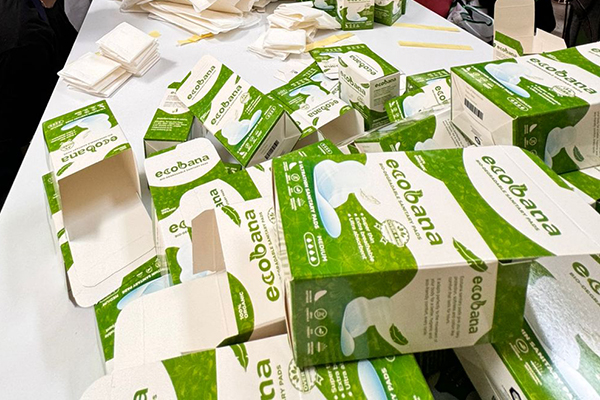
EcoBana is a circular manufacturing project that transforms banana agricultural waste into biodegradable sanitary pads for women and girls in underserved communities. Combining sustainability, local production, and inclusive design, the project offers an affordable alternative to plastic-based imported menstrual products while reducing agricultural and environmental waste. Beyond product innovation, EcoBana integrates menstrual health education, community engagement, and employment opportunities for women and young people. The initiative demonstrates how locally driven design solutions can improve access to safe menstrual care, support resilient local economies, and promote dignity, health, and environmental sustainability through circular production systems.
Founder’s Choice Prize
ROOTS Menstrual Care System by Ellena Vianne, Tria Indah Lestari, Farida Doa Valentina and Adnan Hasyim Wibowo, Universitas Indonesia
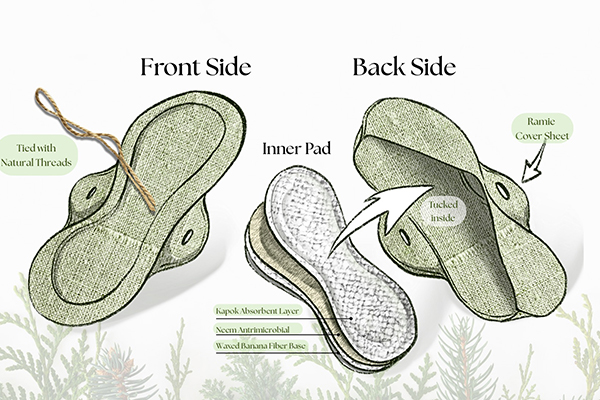
ROOTS is a sustainable menstrual care system developed for the Orang Rimba indigenous community in Sumatra’s Bukit Duabelas National Park. Designed for tropical rainforest conditions, the project combines biodegradable menstrual products, women-led economic models, and culturally grounded health education. The menstrual pads are made from locally sourced natural materials including ramie, kapok, banana fiber, and neem extract, providing quick-drying and antimicrobial protection in humid environments where conventional products are ineffective. ROOTS also supports a women-owned cooperative that creates local income opportunities and community-led production. Educational programmes based on storytelling and oral traditions help address menstrual stigma and improve reproductive health awareness while respecting indigenous cultural practices.
Public Vote Prize
Samvaad Saathi: Service Enabling Financial Inclusion for Women Daily-Wage Construction Workers by Akshat Shah, Harshavi Patel, Aryaa Bhagwat, Centre for Environmental Planning and Technology University, India
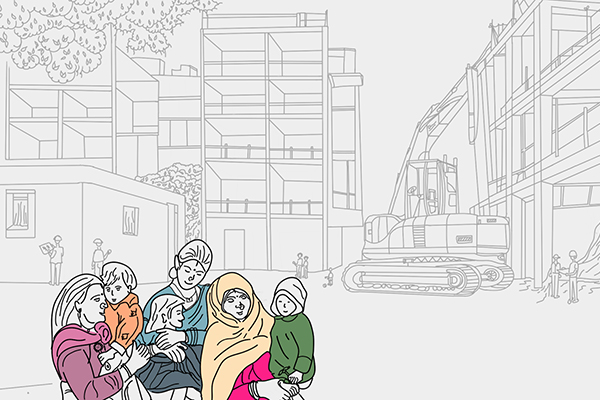
Women daily-wage construction workers earn independently but lack access to bank accounts, pensions, and welfare schemes, limiting financial independence and long-term security. Samvaad Saathi is a practical empowerment service enabling women daily-wage construction workers to take control of their finances and secure their future. The project is based on immersive field work, including interviews, observation, and collaborative workshops with women workers, NGOs, and local authorities, to understand the real challenges they face in accessing banking and social security services. Beyond immediate financial access, Samvaad Saathi empowers women with knowledge, confidence, and long-term planning skills, creating a foundation for sustainable change.